
In this guest blog for International Women’s Day, Gill Crawshaw, a freelance curator of disability art and disability history projects, introduces us to the life and work of Audrey Barker (1932–2002). Barker was a pioneering disabled artist whose work challenged conventional ideas about disability, accessibility, and aesthetics. Although she is not widely known, her practice anticipated many of the debates that shape contemporary discussions around inclusive and multi-sensory art. Following a varied career, in the late 1980s and 1990s Barker developed several multi-sensory installations with accessibility at the core.
My research into Barker’s life and work, begun during the British Art Network Emerging Curators Group 2023 and based largely at the National Disability Arts Collection and Archive (NDACA), has revealed an artist deeply engaged with disability, collaboration, and experimentation. Central to her work was the conviction that “accessibility is a state of mind.”
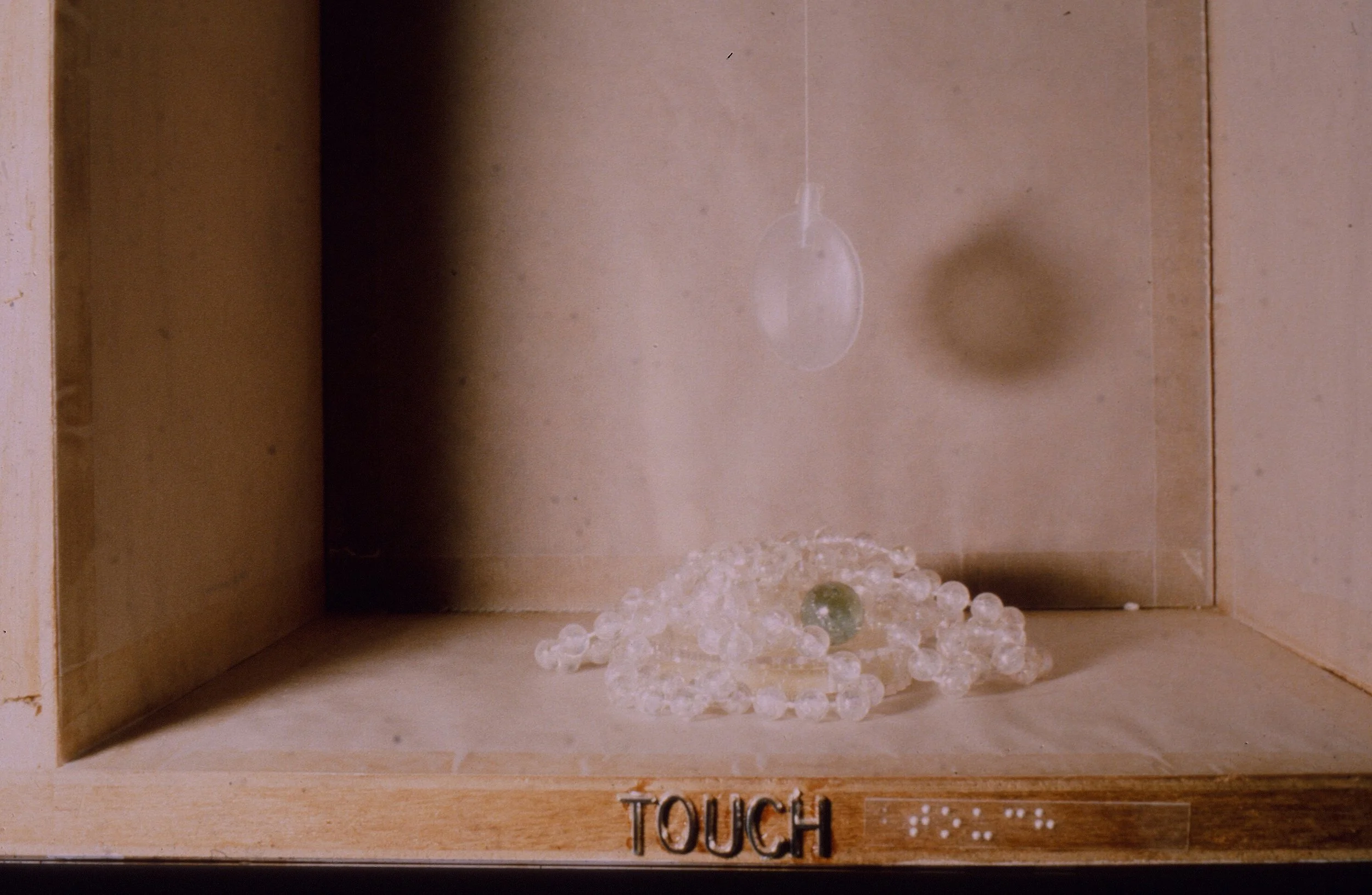
Detail of one of Audrey Barker’s multi-sensory artworks. Date unknown. Photo courtesy of www.the-ndaca.org
Diving into the archives
It took a few repeated visits to National Disability Arts Collection and Archive (NDACA) before I could understand Barker’s practice and motivations. The items that form her archive had been hurriedly swept into several boxes by two of her close friends after her death. The boxes were deposited a few years later with Tony Heaton, the disabled artist who had the vision for NDACA.
By the time I dived in, the collection of thousands of photographs, slides and papers remained uncatalogued, unlabelled and loosely arranged. It was overwhelming, and I struggled at first to make out any clear narrative. Gradually, however, through repeated visits and cross-referencing with various sources, including other archives and conversations with Barker’s friends and colleagues, a clearer picture of the different stages of her career began to emerge. This began in the 1950s, but her focus on accessibility and multi-sensory work developed decades later.
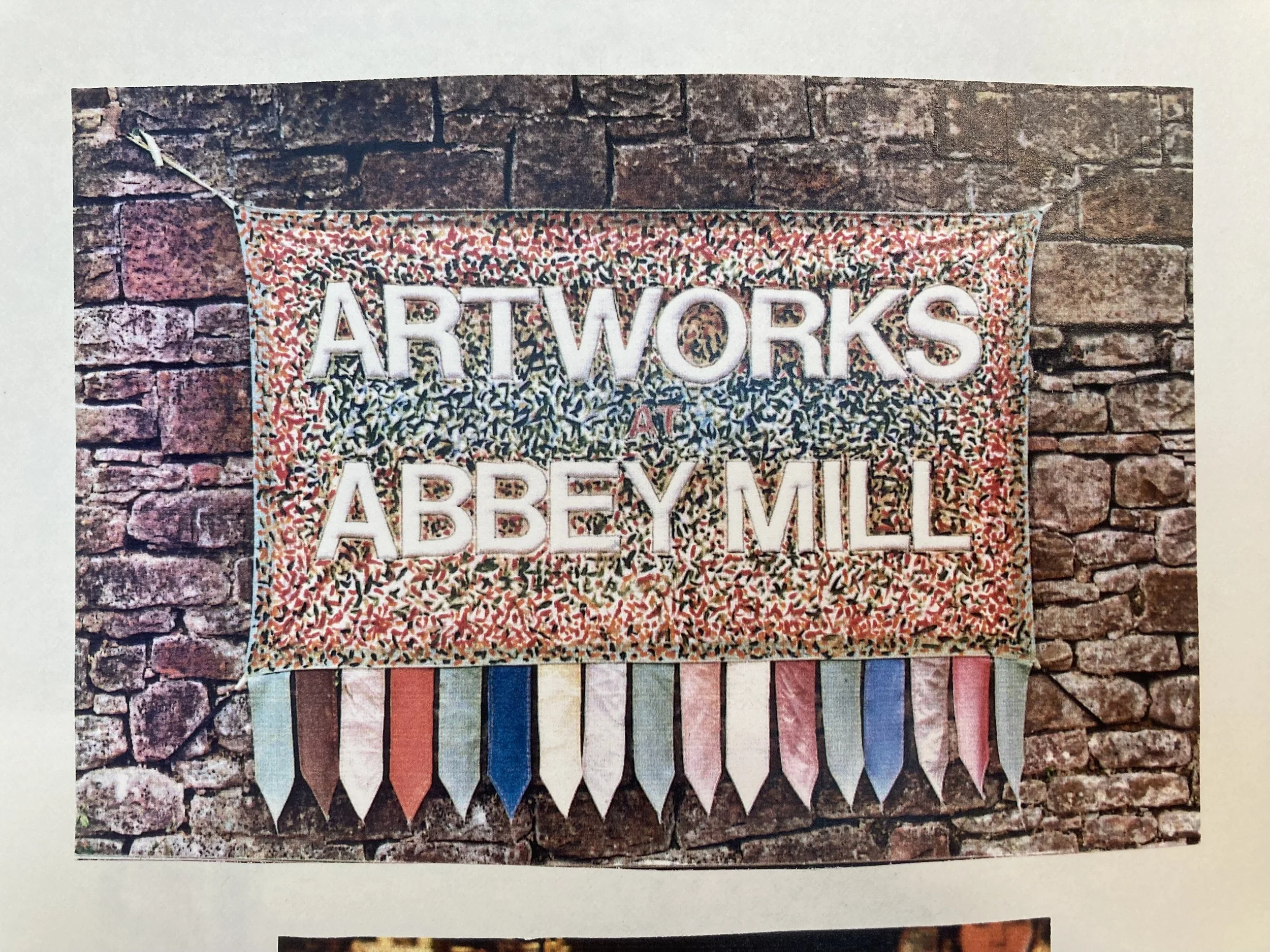
Textile banner outside Abbey Mill Arts Centre, Lanercost, 1980s. Photo courtesy of www.the-ndaca.org
Abbey Mill: an inclusive vision
In 1983 Barker and her husband Denis opened Abbey Mill, an inclusive arts centre in the village of Lanercost in Cumbria, where they lived. Housed in a former corn mill near Hadrian’s Wall, Abbey Mill was organised and staffed by disabled people and open to all. It was founded on principles of equality and inclusion. Barker was clear about its purpose: it was not occupational therapy. It was a serious artistic and educational endeavour.
Abbey Mill operated without statutory funding, relying instead on passing tourists and the Barkers’ own savings. Despite its success in engaging many local people, it closed in 1987. Yet the ideas developed there did not end with its closure. Instead, they evolved into Barker’s most innovative projects.
During the Abbey Mill years, Barker began to experiment with multi-sensory environments:
“The last of many projects undertaken at Abbey Mill was a travelling installation, constructed and contributed to by everybody involved in the building, able bodied or disabled alike.”
This collaboration laid the groundwork for the direction of her art.
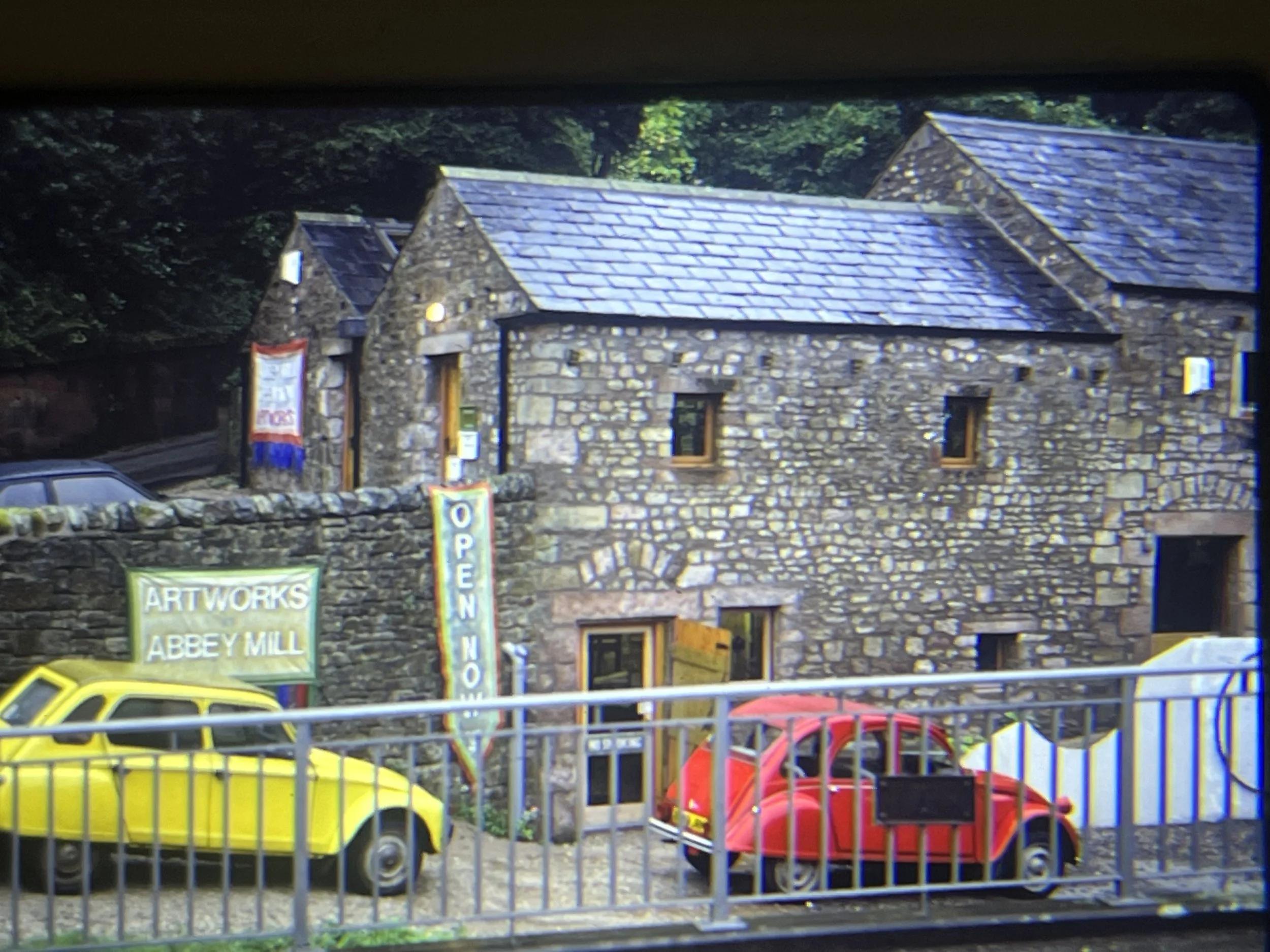
Abbey Mill Arts Centre in the mid-1980s. Photo courtesy of www.the-ndaca.org
Another Way of Seeing
Commissioned for the Art of Disability Festival in Bradford, by local disability arts organisation In-Valid? in 1987, Another Way of Seeing marked a significant development in Barker’s practice. Conceived as a portable and flexible installation, it was designed to fit different venues. It could be an exhibition, a performance space, and—most importantly—it was an invitation to explore all the senses.
The installation included objects to touch, smell, taste, and wear, often with taped commentary. Its purpose was to entice visitors to participate actively and to “redefine the extraordinariness of the ordinary.”
After Bradford, it was shown at the Shipley Art Gallery in Gateshead, at the Laing Gallery in Newcastle as part of their Freedom to Touch exhibition in 1988, then at Kendal Museum in 1990. Hundreds attended at each venue, including local disability groups and schoolchildren.
In 1989 she described using the “using the ‘languages’ of disability as an art form”: incorporating audio, raised text, braille and sign language. She questioned what was considered “normal,” who was “able,” and how aesthetic value was defined. Accessibility was not an add-on; it was the creative inspiration of the artwork itself.
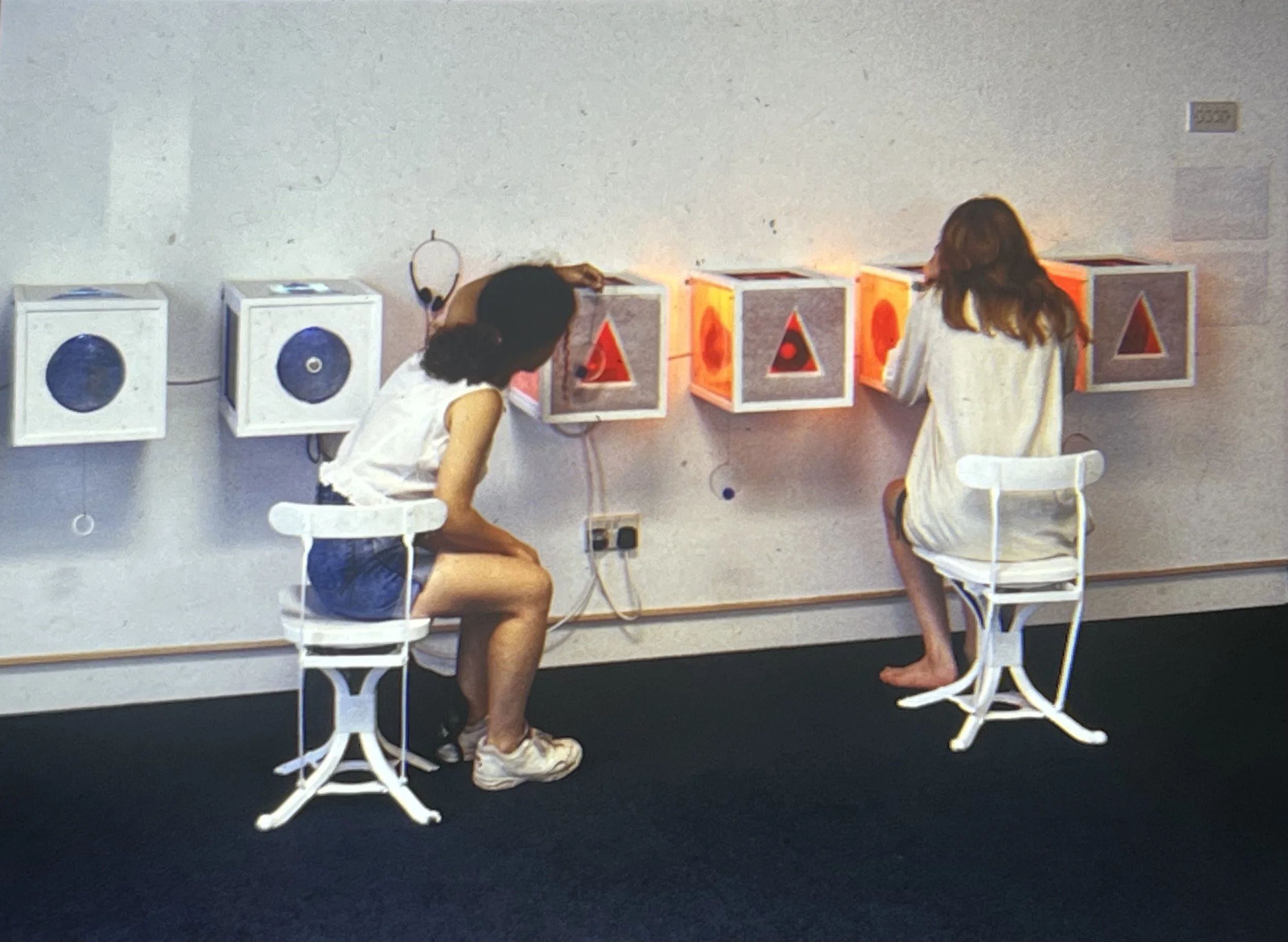
Visitors engage with one of Barker’s multi-sensory artworks. Possibly at Darlington Arts Centre, 1993. Photo courtesy of www.the-ndaca.org
The Festival of the Five Senses
Barker expanded these ideas in 1989 with The Festival of the Five Senses in Hexham, delivered in collaboration with Northern Shape.
This ambitious event combined installations, performances, workshops, and cabaret. The experimental music collective Echo City contributed interactive sound works with their Batphones and Shimmers. The poet Peter Street and actor Nabil Shaban performed, alongside Barker’s long-time collaborator Alex Fraser. Sculptures designed to be touched, by Mark Dunhill, John Joakes, and Jennie Norman, were also included.
The core of the festival, which took place in a leisure centre, was Barker’s large multi-sensory environment. This choice of venue enabled Barker to reach beyond established art audiences. It attracted thousands of visitors, many drawn in from the leisure centre or adjacent supermarket.
Visitors were encouraged to touch, listen, make sounds, and immerse themselves physically in the space.
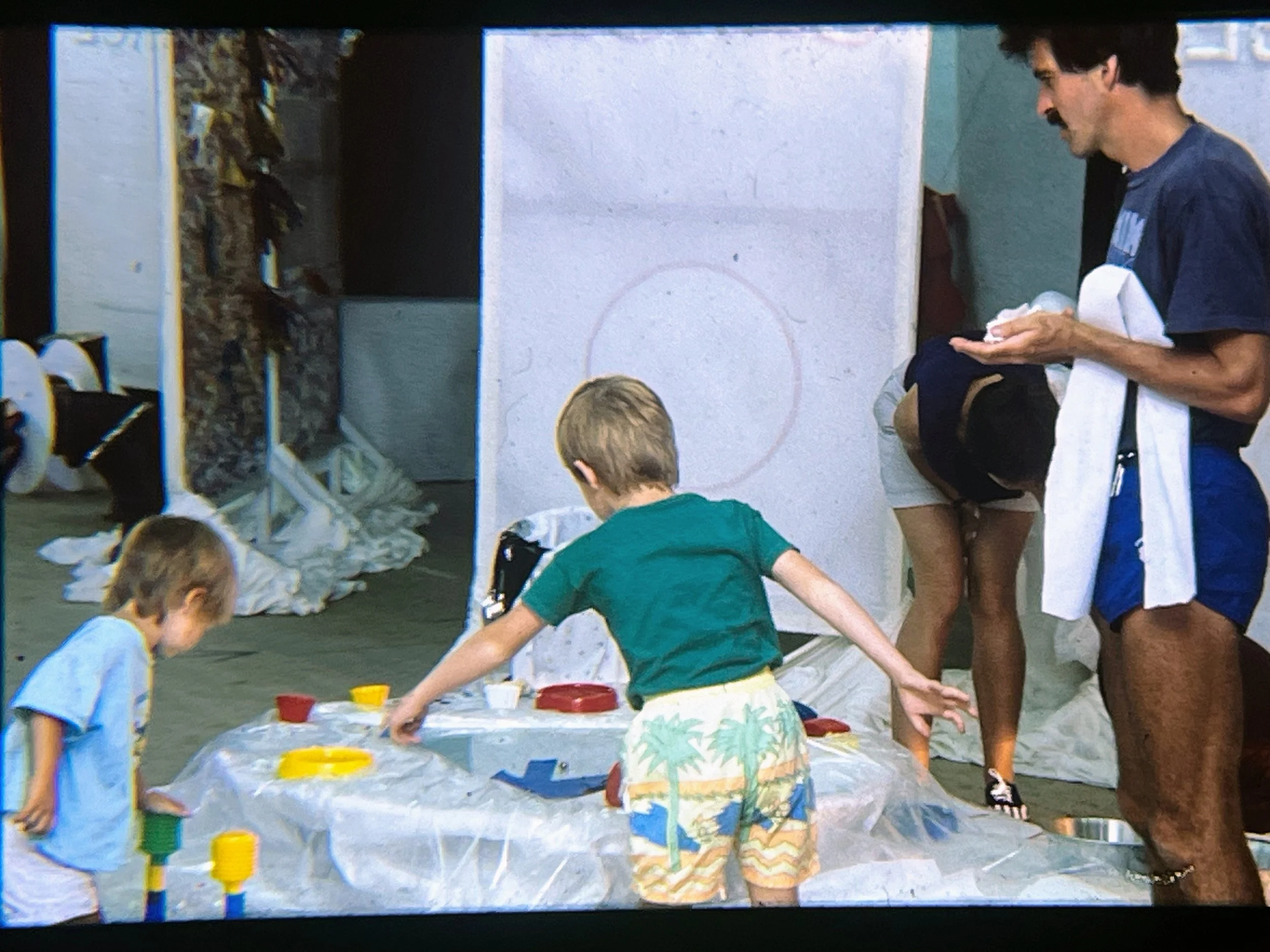
A family enjoys Barker’s installation at The Festival of the Five Senses, Hexham, 1989. Photo courtesy of www.the-ndaca.org
Further installations
In the 1990s Barker continued to develop multi-sensory installations that responded to specific sites, mainly in Cumbria and the North East. An exception, ILLUSION OF BELONGING-S, presented in a Croydon shopping centre in 1991, raised issues of consumerism. A Different View (1992) at Tullie House in Carlisle carried an anti-war message and incorporated workshops and performances.
Her approach to placing objects in boxes, frames and grids as part of her installations had roots in her earlier boxed assemblages, or “Compartments“ of the 1960s. By the 1990s she was intervening in gallery spaces, sometimes disrupting conventional display practices to encourage tactile and sensory engagement so that audiences might perceive things differently.
Disability as creative inspiration
Barker’s practice was shaped by lived experience of impairment and disability, her own and that of those around her. She engaged with local disability organisations, researched with the RNIB, and served on Arts Council disability committees. She didn’t frame her work as compensatory or as ‘making the best’ of limitation. Disability, for Barker, was a source of insight and artistic innovation.
Her projects asked fundamental questions: What counts as art? Who is it for? Which senses are privileged, and why? By embracing multi-sensory experience and collaborative production, she anticipated later developments in participatory and socially engaged art.
Audrey Barker deserves greater recognition not only as a disabled artist but as a thinker who expanded the language of contemporary art. Her insistence that accessibility could reshape aesthetics, rather than merely adapt to them, remains both radical and relevant today.
Gill Crawshaw
Thanks to the British Art Network for support, through the Emerging Curators Group 2023, and with a bursary to connect with Keswick Art Gallery and Museum, the venue for Barker’s last exhibition during her lifetime in 2000. A research grant from the Paul Mellon Centre enabled further research, including with the Arts Council Archives at the V&A. And particular thanks to NDACA for access to Audrey Barker’s archives there.
Thumbnail image: Detail of one of Audrey Barker’s multi-sensory artworks. Date unknown. Photo courtesy of www.the-ndaca.org