Yorkshire and North East Film Archive - In the Veins - Highly Commended Archive Volunteering Award 2026
In the Veins is a project by Yorkshire and North East Film Archive on partnership with Teesside University. The project began in 2024 and ended in November 2025.
‘In the Veins’ is a short film that resonates through time, using over a century of archive footage to shine a light onto the face of the mining heritage of Yorkshire and the North East of England.
A story of hardship and hope, division and defiance, perseverance and pride; In the Veins is not a history lesson, it’s an emotional journey that digs deep into the heart of a community built on coal.
Telling the story of the coal industry, but importantly the human experience, through only archive footage and found voices in the vaults of the Yorkshire and North East Film Archive was a massive undertaking.
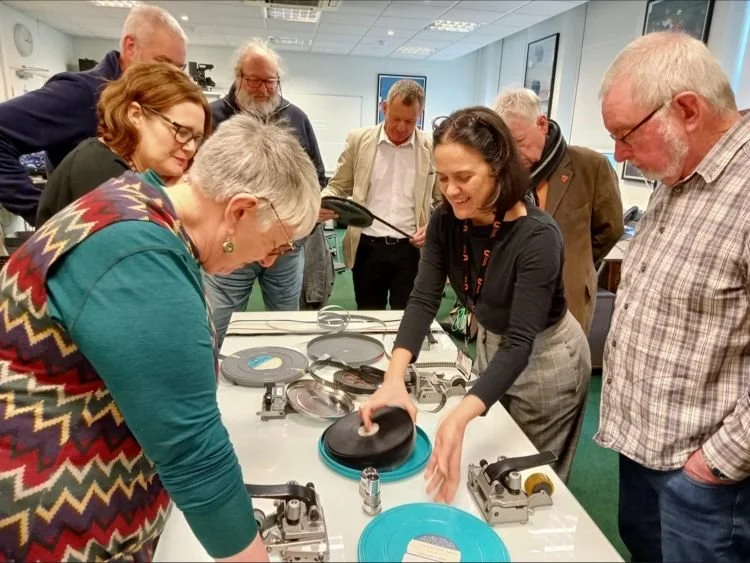
Central to the success of the project was the diverse volunteer ‘community curator’ group, who helped shape the production. The 13-strong group have lived and worked in mining communities, at the coalface, in the community. They were invaluable; they provided emotional responses, factual advice, and ideas for how the film could connect with audiences, their communities, in a meaningful and authentic way.
“Using us as community curators was by no means just a box ticking exercise, all of our perspectives were valued and definitely incorporated into the final film.” David Lister, volunteer and former consultant coal mining geologist.
“Some people have blood running through their veins, I think we’ve got coal dust!” ~ Miner’s daughter
2024 saw the anniversary of the 1984/5 Miners’ Strike, one of the longest industrial disputes of the 20th century, the long-term impact of the strike still resonates today.
Four decades on, the strike provided an opportunity to reflect on the rich history of mining in the UK over the last century and how it affected the people, places, and identity of those involved.
For centuries, men toiled in the bowels of the earth to build a nation, creating prosperity and improved standards of living, before experiencing the gut-wrenching end to livelihoods, a cost to people and their communities that is still having an impact across the generations.
From those who worked the mines to their children and grandchildren a few steps removed, the target audience for ‘In the Veins’ included ex-coal mining communities but also those not connected to the industry, young and old.
We wanted to connect with people, enabling audiences to remember and experience anew how coal still runs through the veins of their heritage; to feel included, engaged, and validated with their cultural heritage, authentically.
The project had multiple stakeholders including, underserved mining communities, the wider public in the North of England, exhibition venues, funders (AHRC Impact Acceleration Account fund) and the partnership between the Yorkshire and North East Film Archive at York St John University and Teesside University. The archive staff underpinned the venture, but the volunteers turned out to be the most important stakeholder.
Experienced in archive research and visual storytelling, the archive’s biggest challenge was not the content per se, but rather the responsibility to tell a sensitive human-centred story about a proud but often forgotten community built on coal. That’s where the volunteers were instrumental.
Recruitment was key, Ben Lamb at Teesside University led the charge to reach out to volunteers across the two regions, researching and targeting specific individuals. We also piggybacked on external organisational communications to ensure greater representation and opportunities, the most fruitful of which was the Friends of Redhills (the County Durham Pitman’s Parliament) mailing list.
The volunteer community curatorial group were diverse, representing different geographical locations, generations, genders, race, and connections to the mining communities.
We created a welcoming and safe space to allow the volunteers to contribute to the production. It was a very iterative process, and we cannot underestimate the contribution of the volunteers
“I'm really glad we had our discussions as it brought up a lot of ethical issues that we had different views on that we were able to navigate sensitively through a politically balanced group consensus.” Julie Ward, community curator, Jack Drum Arts Founder
The archive team were acutely aware that this wasn’t ‘our’ story, we had a responsibility to produce a respectful production that would represent generations of coal mining families with integrity. We couldn’t do it on our own, we needed the lived experience of those who understood the industry and the communities that it supported.
Initially the volunteers were sceptical, some cited ‘academics’ who they had previously put their faith in to tell their story, and who hadn’t reflected their experiences accurately. Trust played a huge part in the process.
We shared our ambitions for the production, importantly we communicated how we valued their insight. We needed to be thoughtful and considerate to their stories and experiences.
We showed them a previous film we’d made called ‘Cost of Living’, sensitive and impactful, this gave them the confidence that we could deliver.
The process involved in-person meetings at the Archive followed by regular online video calls. This was truly a co-curated production; the community curators were critical to the process. The volunteer’s insight into the industry, underpinned by the raw emotion still connected to their heritage was channelled into the production and informed how we reached audiences.
“I was initially dubious about working on this project as whenever I usually work on university projects academics will often tell me what it was like to work down the mines and inform me that my perspective and memories are not accurate. Here however the film accurately portrays the importance of coal to the world through to its demise. There is a sense of community, defiance and mining culture throughout.” Stephen Guy, volunteer community curator, former miner and Chairman of the Durham Miners’ Association.
The community curator group consisted of 13 volunteers, all helped co-curate In the Veins, shaping the narrative, clarifying historical touchstones, and providing feedback on the emotional hooks. Many of the volunteer community curators also joined Q&A panels following screenings of the film.
In addition to the community curators, we had approx. 10 volunteer community champions who helped arrange and support screenings of the film. Importantly, they ensured In the Veins was screened in community centres and village halls in former mining communities across the North of England.
First screened at the Women X Festival, Darlington, in September 2024, the film has since been programmed in Museums, Libraries, universities, independent cinemas, working men’s clubs, pubs and at film festivals, including ‘Activists Without Borders’, ‘North East International’, ‘Manchester Lift-off’ and ‘Sunderland Short Film Festival’.
“It was history come to life” Women X Film Festival audience member
From toddlers to grandparents, over 650 people enjoyed the film in the Grand Cinema at Beamish Museum; lively debates were had at the Coal Mining Museum, and in York, the Golden Rail Band accompanied the film by performing iconic music from the film “Brassed Off”.
The final production, co-curated with volunteers, was published on YouTube in March 2025 to coincide with the 40th anniversary of the end of the 1984/85 Miners Strikes and has since had over 30,000 views: https://www.youtube.com/watch?v=LyQxrchc8bc. It has also been shown at over 40 in-person events, over 2000 people have experienced the film.
This approach to using volunteers was new for the Yorkshire and North East Film Archive. Traditionally we’d used volunteers to help with the cataloguing or contextualising of our collections or having an extra pair of hands at events. In the Veins presented an opportunity to co-curate our collections to ensure authenticity in the outcome (the film) resulting in meaningful engagement (the impact).
Impact
The volunteer impact has been particularly noteworthy:
“I felt that our contributions were very valued, and we could see many of our suggestions being put into practice. Yes, very empowering. I feel a sense of ownership re the project and have added it to my CV!” Julie Ward, community curator, Jack Drum Arts Founder
“The film shows the importance of coal, how it kept us all warm, how it kept the wheels of industry turning and how communities came together as each pit was sank. It shows the price of coal, the deaths and illnesses caused by mining the black gold. It shows the strength and tenacity of miners and their families who over the years fought for a fair wage, better working conditions and in 1984 fought the state hoping to keep jobs and community. It tells our story and it tells it well!” Heather Wood, community curator (active in the ‘Women Against Pit Closures’ movement)
“It brought communities together over a subject that introduced people to their library, was a conversation starter, and gave people the chance to mix socially.” Suzanne Green, Community Champion and Library Engagement Support Officer, County Durham Libraries
“The local mothers club are very supportive of this type of event and it gives them the opportunity to remember their part in aspects of the film.” Margaret Hedley, volunteer Community Champion and Chair of Wheatley Hill History Club
Impact on audiences has been incredible, we’ve seen the whole gamut of emotional responses: anger, sadness, questioning of the past – but the power of the collective, community, and sense of identity has shone through the dark times. Feedback forms were used at all screenings with a return rate of over 50%, comments demonstrated the impact on audiences.
Those with connections to the mining industry could reconnect with their history and feel proud of their identity:
“As a family with union roots during 80s strike, very emotive. Excellent education for the children.”
“A wonderful evocation of a community. I teach in the West Yorkshire Coalfield and sadly my students are losing this history - their stories.”
“Three generations of us watched it intently. Fantastically put together.
It demonstrated how important it is to retain and preserve film archives for future generations to understand their past.”
Those with connections to the mining industry could reconnect with their history and feel proud of their identity:
“A discussion around the humanity of the history. History is often portrayed as about big events and major figures not "normal" people. Gave a history and voice to the mining community.”
“It evoked memories of my childhood and of the community spirit at the time. I enjoyed the group chat afterwards and sat glued to my seat through the film - yes - amazing. I'm a miner's daughter and proud my dad did 36 years and 35 weeks in the mines.”
“Really informative and gripping piece. Quite awe-inspiring to see the archive footage and hear from the people in the footage.”
People with varying levels of connection to their mining heritage had their perspective changed on the past and present state of their communities:
“I really enjoyed it. I am ashamed to admit my ignorance regarding this topic. It was accessible, informative and thorough. I really was impacted by it.”
“I was brought up in Surrey and it’s remarkable to see the events of 1984 from a northern perspective. Growing up our news programming always made it seem as if it was simply some northern miners causing trouble with the police. I have so much more understanding of the context now.”
“Interesting introduction to records and archives of the North East, which I did not know existed.”
The feedback forms at events were our main method of evaluation. Of the 2000+ members of the public who attended a screening/knowledge exchange:
96% found the event either very good or good
72% had never attended an archive film screening before 60% felt further informed
54% now think differently about the UK mining industry in some way (bearing in mind these are particularly informed audiences on the subject already)
41% felt proud
13% felt empowered
Benefits have not just been to the volunteers and the public, we also surveyed the partner venues who hosted an event, with an overwhelming response to the screening of the film and the wrap around activities:
“The audience developed a deeper understanding of the theme of the week and having first hand images of protest enhanced their experience. We have now developed a closer working relationship with the Yorkshire and North East Film Archive to put on more screen heritage here at the museum, as there is certainly a meaningful impact for those who have been able to attend the various things that we have put on through the year.” Connor Emerson, Curator of Social History, Beamish Museum
“It was brilliant to collaborate with Teesside University and the Film Archive on the project bringing in a new audience to ARC. For the audiences accessing ARC, for some of whom may have been the first time, it certainly widened their cultural opportunities in future.”
Parissa Zarifi Programme and Hires Coordinator ARC Stockton Arts Centre Cinema
“It was another way for us to connect with our mining communities by showing films that are relevant to them and their lived experiences. We have received a donation of material for the collection as a result of the screening. It has helped us to strengthen our working relationship with Yorkshire and North East Film archive and introduced us to Teesside University as another partner we could work with in the future. There was a clear emotive response to the films from the audience and the level of engagement during the Q&A showed that the audience had enjoyed and connected with the films. I think this type of film and the screening of it helps our mining communities to feel valued and seen.” Katie Cavanagh, Head of Collections, Exhibitions and Digital, National Coal Mining Museum for England.
Achievements and media coverage
The volunteer co-curated 24-minute film has exceeded our expectations, both in-person screenings, online views, and the impact it has had on audiences. The film has been shortlisted for three international awards, winning one, these are:
Shortlisted: FOCAL International ((Federation of Commercial Audiovisual Libraries) Award 2025 for Best Use of Footage in a Short Film Production. https://focalint.org/awards/archive/2025?category=31624
Shortlisted: FIAT/IFTA (International Federation of Television Archives) Archive Achievement Awards 2025 for Archive Production. https://fiatifta.org/awards-editions/awards-2025/
WINNER: Broadcast Tech Innovation Awards 2025 for Best Use of Archive. https://www.broadcasttechawards.co.uk/winners-2025
Nominated alongside documentaries from Sky, the BBC and CNN, the judging panel felt the locally produced film was 'a masterclass in sensitive, human-centred archival storytelling’.
In the Veins has also been nominated for a prestigious Best Screen-Based Practice Research Award at this year's British Association of Film, Television and Screen Studies (BAFTSS) conference and awards.
The project has been selected as a case study for the National Archives’ Year in Archives https://www.nationalarchives.gov.uk/archives-sector/our-archives-sector-role/celebrating-archives/a-year-in-archives/
Coverage of the project and the short film has been overwhelmingly positive and varied, including:
Sunderland Echo call out for volunteers: https://www.sunderlandecho.com/retro/sunderland-durham-mining-history-documentary-4569004
Cultured North East (featuring volunteers): https://www.culturednortheast.co.uk/p/miners-strike-film-digs-deep
BBC Sounds (Executive Producer Ben Lamb from Teesside University talks about the volunteer contributions): https://www.bbc.co.uk/sounds/play/p0j1x6y0
Independent film review from Tom May: https://letterboxd.com/film/in-the-veins/
York Press: https://www.yorkpress.co.uk/news/24840024.coal-mining-film-veins-york-screening-ncem/
University of London History Day: https://exhibitions.london.ac.uk/s/history-day-discover-collections/item/2177
Film Archives UK: https://www.filmarchives.org.uk/new-film-highlights-archive-film-to-mark-40th-year-since-the-end-of-the-miners-strike/
Our top tips for co-curating a visual story using archive are:
Listen, really listen. The subject matter, and how their communities are being portrayed is so important, especially as their story has been told before in ways that they haven’t agreed with. This was an emotional experience for the volunteers involved, they cared deeply. The process can’t be a tokenistic gesture.
Maintain editorial control. Know your strengths and roles. The volunteer community curator group had a very heated but healthy conversation triggered by a shot of children sliding down a slag heap. Some said it made them think of the Aberfan disaster and suggested the shot should be removed, others said it brought back happy memories of playing on slag heaps as children. Respecting different viewpoints is important, but editing by committee does not always result in the best outputs. The shot of the kids sliding down the slagheap remained, in the main because it acted as a catalyst for conversation, to discuss different perspectives, allowing audiences to remember and learn from the past, both the good and the bad.
Value their time, expertise and experience. Good communications are key, updating volunteers regularly and clearly, allowing suitable time for responses and feedback. The volunteers know their communities, how they feel and react, much better than we do. The volunteers are valued and need to feel valued.
The learning from this project provides the archive with a template for future productions and community outreach. The volunteers were key to advising and co-producing the short film (and programming) to ensure it was emotionally resonant and had an historically accurate tone, structure, and feel. This is a framework for effective and successful human-centred storytelling that really connects with communities demonstrating and promoting good practice within the archive sector.