
Help with submitting your paper to ARA’s 2026 conference
Following our successful webinar on Wednesday 28 January the following blog gathers together some of the information shared in that session. You can find the full Call for Papers here. The ARA Conference 2026 takes place 5-7 August at the Radisson Blu hotel in Glasgow, UK.
Overview of the ARA Conference from Annie Starkey, Conference Chair
The ARA conference is an annual event where colleagues from across the record-keeping sector and beyond can meet, share experiences, discuss and learn. It usually spans across four themed strands so hopefully there is something for everyone. Everyone is welcome - the friendly atmosphere of our conferences have is a point of great pride for us.
The conference committee itself is made up of ARA staff and volunteers. ARA members take on the roles of Chair, Programme Co-ordinators and Comms officer, representing the ARA membership. We work alongside the professional events organisers – Opening Doors and Venues, who ensure the smooth planning and running of the conference – and our AV company – Andrew Mills Ltd, who, unsurprisingly, they take care of our AV needs. And finally CPL One who sort out exhibition sales so we can afford to run the conference!
Planning the conference is a continual process that usually starts, with venue finding, over a year before we've even had the present conference. The next step is for the Chair to write the call for papers and this is then shared with the rest of the committee for test driving. ODV then build the website based on the call for papers and venue before we open for submissions. Once the call for papers closes, the shortlisting can begin and the programme can be built. After we have a good amount of speakers confirmed we can then open registration after carefully calculating delegate rates – our aim is always to break even – not profit.
Amongst all of this the committee meets once a month, to go over the finer details such as menus, social events and accessibility needs.
EDI and sustainability is at the heart of what we do and we are always seeking to improve on this where possible.

Julz Davis of curiosity United giving the keynote speech at our conference in Bristol in 2025
What we are hoping from the archive conservation community – from Katie Proctor, Conservation programme co-ordinator
This year’s theme—Authenticity—is particularly resonant for archive conservators. We work at the interface between the physical record and the future user, and our decisions can either reinforce or complicate how authenticity is perceived, experienced, and safeguarded.
For conservators, a strong submission might explore:
The tension between stabilisation and alteration of physical objects.
The ethics of interventive versus minimal treatment approaches.
Whether conservation choices shape interpretive authenticity or physical authenticity—and how.
Case studies where treatment decisions changed user perception or archival value.
We encourage you to highlight not only the what, but also the why behind your decisions, grounding them in professional ethics and reflective practice.
The inherent instability or technological obsolescence of traditional formats may see us questioning how we can provide a user with an authentic experience, accessing often fragile items and born digital media. Considerations around physical displays, the use of surrogates etc might also fit our theme this year.
Conservators could also reflect on the ethics in the use of AI and machine learning.
Individual papers are a great opportunity to cover case studies in which authenticity has played a factor on your decision making.
Panel sessions can be used to begin discussion around how us, as conservators, can begin to think about the ethical decisions we make around conservation treatments and the preventative conservation methods we employ to prolong the lives for the items we care for.
Workshops are a wonderful opportunity for you to demonstrate treatment processes you have used and how these processes may affect, or not, the authenticity of the item itself.
I encourage every one of you to consider submitting. Bring your case studies, your dilemmas, your experiments, your ethical reflections, and your research. The field needs your voice—thoughtful, honest, and grounded in the realities of conservation practice.
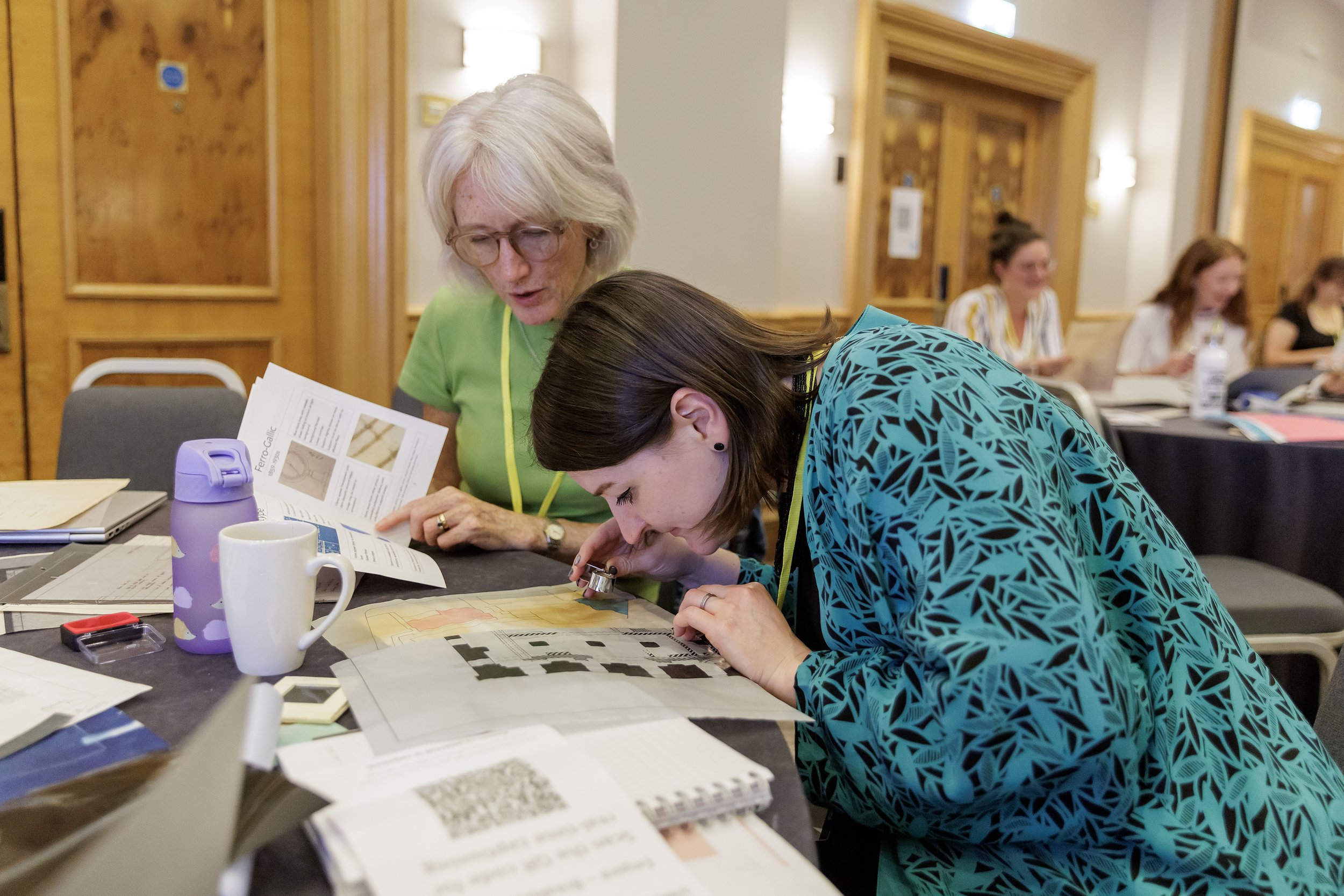
A conservation workshop from our Bristol 2025 conference: Building Better Homes - Shirley Jones and Elizabeth Stettler
Carly Randall our programme co-ordinator gives tips on what makes a good submission and how to stand out from the crowd
I co-ordinate the conference programme for the archives, records, information governance and digital strands. Below I have what I look for when considering the abstracts we receive and the kinds of qualities that send an abstract to the top of the list when it comes time to actually build the programme.
Key considerations. There are six qualities that tend to increase an abstract’s chances of being included in the final programme. An abstract does not have to hit each of these criteria to be successful, but it’s a useful framework to compare your abstract against in order to judge whether it’s ready to submit.

1. Who is your target audience?
Before you compose your abstract, try to picture the kind of delegate who would benefit from attending your session. Having this clearly indicated will help show the conference team where your paper should fit into the programme. And during the conference, your session will have a higher chance of attracting the right audience. Imagine the kind of challenges your target audience deals with – how can you write an abstract that convinces them you have the solution to their issues?

2. How will the delegate benefit from attending your session.
This leads on from the first consideration. It’s not enough to tell delegates that your paper, workshop or panel will benefit them. Try to be specific about how. For example, will they walk away with a framework they can apply elsewhere? Or will they get a chance to take part in guided discussions? Or will they leave with a more rounded understanding of a topic or issue?

3. Sell your ideas (not your collection)!
Your abstract should focus on the central topic your session will be exploring. It’s good to cover if your session focuses on a specific collection or project, but try not to get too bogged down in the abstract by describing the collections you work with if it’s not absolutely relevant. Ideally, your session needs to have a central message or takeaway behind it and not just boil down to a description of a collection or project. Keeping asking yourself: Why does this matter beyond this project or this collection?
4. Tie your abstract into the theme and don’t be afraid to make it obvious.
The call for papers is full of keywords and phrases you can poach for your abstract. They’re for your benefit. If they fit, use them.

5. Keep it snappy.
Longer abstracts aren’t always better abstracts. Don’t feel pressured to use every last word. Some of my favourites have been a fraction of the total wordcount.
Also, avoid jargon and excessive use of acronyms unless they’re absolutely relevant.
6. A strong title can do a lot of heavy lifting.
For one, it helps me get a good first impression of your abstract and what you want to deliver.
Second – during the conference itself, a delegate might arrive at conference without a plan for which sessions to attend. They might not have time to read your abstracts. But they will see your title. It doesn’t need to be flashy and it shouldn’t mislead anyone, but it should make your offering crystal clear.
Here is an example of a strong abstract from last year’s conference. It’s for a 60 minute workshop and was submitted by Anne Cornish, CEO of RIMPA Global. Based on the feedback, I think this was one of the most highly rated sessions we had that year.
Example submission by Anne Cornish, CEO of RIMPA Global, ARA Conference 2025 - the blue text highlights the parts I’d like to draw your attention to:
Future First: Shaping the Future of Our Industry (Workshop)
The need to evolve as an industry has never been more critical. In a world characterised by rapid technological advancements, shifting societal expectations, and evolving workplace dynamics, the future of our profession hinges on our ability to adapt and innovate. Now is the time to take decisive action to ensure the relevance and sustainability of archives and records and information management for generations to come.
This interactive and engaging workshop presentation will challenge participants to think critically about the future of the industry and their role within it. The session will explore and evaluate the key aspects of current practices, including the skills required to remain competitive, the changes needed in practices and processes, and how we can reimagine the delivery of our services to meet evolving demands. Beyond operational shifts, the workshop will emphasise the importance of mindset, encouraging participants to adopt forward-thinking attitudes that embrace innovation and adaptability.
Through guided discussions, collaborative exercises, and thought-provoking activities, attendees will have the opportunity to share perspectives, identify challenges, and co-create strategies to address the most pressing issues facing our industry. By examining how we work today and envisioning what we must do differently tomorrow, this session will provide valuable insights and actionable takeaways to help shape a thriving, future-ready profession.
Example submission by Anne Cornish, CEO of RIMPA Global, ARA Conference 2025
What makes this abstract strong is that it has a strong central premise, is clear about who its audience is, and lets us know what delegates can expect if they attend.
I’ve highlighted the key parts here. The abstract begins with a central statement or issue: that rapid technological advancements and changes in social expectations and workplace dynamics are having an impact on our profession and Anne argues that we need to adapt.
Anne then outlines the workshop session – that it will explore and evaluate key aspects of current practices and the skills required to remain competitive in today’s environment. The abstract also emphasises that mindset is as important as hard skills development.
In the third and final paragraph, the abstract informs us that the workshop will involve guided discussions, collaborative exercises and thought-provoking activities and that the session will provide insights and actionable takeaways.
Overall, this abstract is clearly written in plain English with no jargon and remains focused on a central argument throughout. It ties in well with that year’s theme of imagination and innovation by arguing that we need to reimagine the delivery of our services.
It makes clear that delegates will be expected to contribute to discussions and do activities during the workshop. And it is spells out the benefits delegates will receive by participating.
It's also well formatted with good grammar and spelling.
Not every abstract needs to match this structure. But you can see how this example utilised the strategies I’ve discussed to effectively sell this workshop to our delegates and also to me as the person building these strands into the programme.
Help using the portal for you submission – Madalina Marancas – Opening Doors and Venues
During the webinar Madalina talked through the submission process – this has also be captured in this ‘how to’ video here:
If you need further help with your submission, or encounter any technical issues not covered by this video please get in touch with: araconference@opening-doors.org.uk