
I am nominating Dr Paul Beard as an exceptional new professional who is making a meaningful impact to the profession through his research, publications and practice in the area of charity archives and records. He is a highly collegial and supportive colleague who is strongly deserving of this recognition.
Paul completed his PhD in archives and records management at UCL in 2025 and since submission of the thesis in June 2025 he has worked as Records Manager at the Salvation Army. Paul’s thesis was an AHRC-funded collaborative doctoral award (2021-2025) which was a partnership between UCL (supervised by Georgina Brewis and Elizabeth Shepherd) and The National Archives (supervised by Kathryn Preston and Tina Morton). Completion of the study (‘Charity and voluntary archives at risk? Conceptualising and contextualising a neglected archives sector) was a key objective of the Charity Archives Development plan, a strategic initiative launched in 2022 to improve the preservation, visibility and long-term sustainability of charity archives across England. As part of his studies, Paul completed two placements with the Archives Sector Development team at TNA as well as working part-time as a research assistant on the British Academy Research Project (ARP), ‘Archiving the Mixed Economy of Welfare’.
Paul’s research draws on data collected from eight case studies. Six of the case studies were of charitable organisations of varying shapes, sizes and purposes selected based on their approach to record-keeping. Two of the case studies discussed academic projects that sought to improve access to charity archives. Data collection included 33 semi-structured interviews, extensive fieldwork visits, stakeholder events attended by over 40 participants, and desk-based research. Study participants included sector leaders from both record-keeping and voluntary sector bodies, charity senior leaders, charity staff, volunteers, and record practitioners.
Paul’s research is the first to provide robust evidence about the current state of voluntary sector archives in England. It questions the extent to which voluntary sector records should be seen as at ‘risk’, concluding that there has been considerable progress in this area since the 1990s and that many charities are now leading the way in innovative archival and record keeping practice, particularly in person-centred practice. However, the research also shows there is a strong appetite for further support and guidance – and he identifies four key policy challenges:
In England, there is a complicated and confusing legal and regulatory framework that is unclear on what the record-keeping expectations for charities are.
There are considerable inequalities in terms of access to records due to few legal protections outside of the Data Protection Act 2018.
The guidance and advice available to charities differs between public agencies, infrastructural bodies, and professional associations. In some cases, published guidance and advice documents are contradictory.
There is limited capacity in charities to improve or implement professionalised record-keeping.
Paul has spoken at a very wide range of events about his research and his wider work. To give a couple of specific examples, on 13 May 2026, the British Academy hosted a one-day event on ‘Charity Archives and Records Now’ at which Paul’s research findings were debated by a panel of leaders from both the archives sector and voluntary sector to respond to these challenges including Head of Guidance at the Charity Commission, Mazeda Alam, Islamic Relief archivist Daniella Gonzalez, Jay Kennedy from voluntary sector infrastructure body Directory of Social Change and TNA’s Chief Executive Saul Nassé. He has arranged a panel with colleagues from CHARM at the ARA conference in 2026.
Over the past 5 years, Paul has produced and supported the production of a range of important practical resources as well as academic contributions that will make a real difference to many people working with charity archives, which include:
A project mapping the archives of charities in England. Results from this work are available on TNA’s website Mapping Charity Archives
Case studies of charity archives for Charity Archives Development Plan – Archives sector, available here: https://www.nationalarchives.gov.uk/archives-sector/advice-and-guidance/resources-by-archive-type/charity-archives-development-plan/outputs/case-studies/
A policy briefing document to be published by UCL in late 2026
A number of academic articles including:
Paul Beard and Georgina Brewis, ‘Different Traditions: Understanding the Archives and Record Keeping Practices of students’ Unions in Britain’, Cultural and Social History, 1–19. Open Access: https://doi.org/10.1080/14780038.2025.2577348
Paul Beard, ‘Are charity records ‘at risk’? Understanding record-keeping in charities and voluntary organisations in England’, Accepted for Archives
Henry Irving, Paul Beard and Georgina Brewis ’Archiving the History of Environmentalism: Insights from Academia and Practice’, Accepted for History
Paul’s research underpinned the production of ‘Collecting students’ union archives: Guidance and case studies about students’ unions’ published by The National Archives here
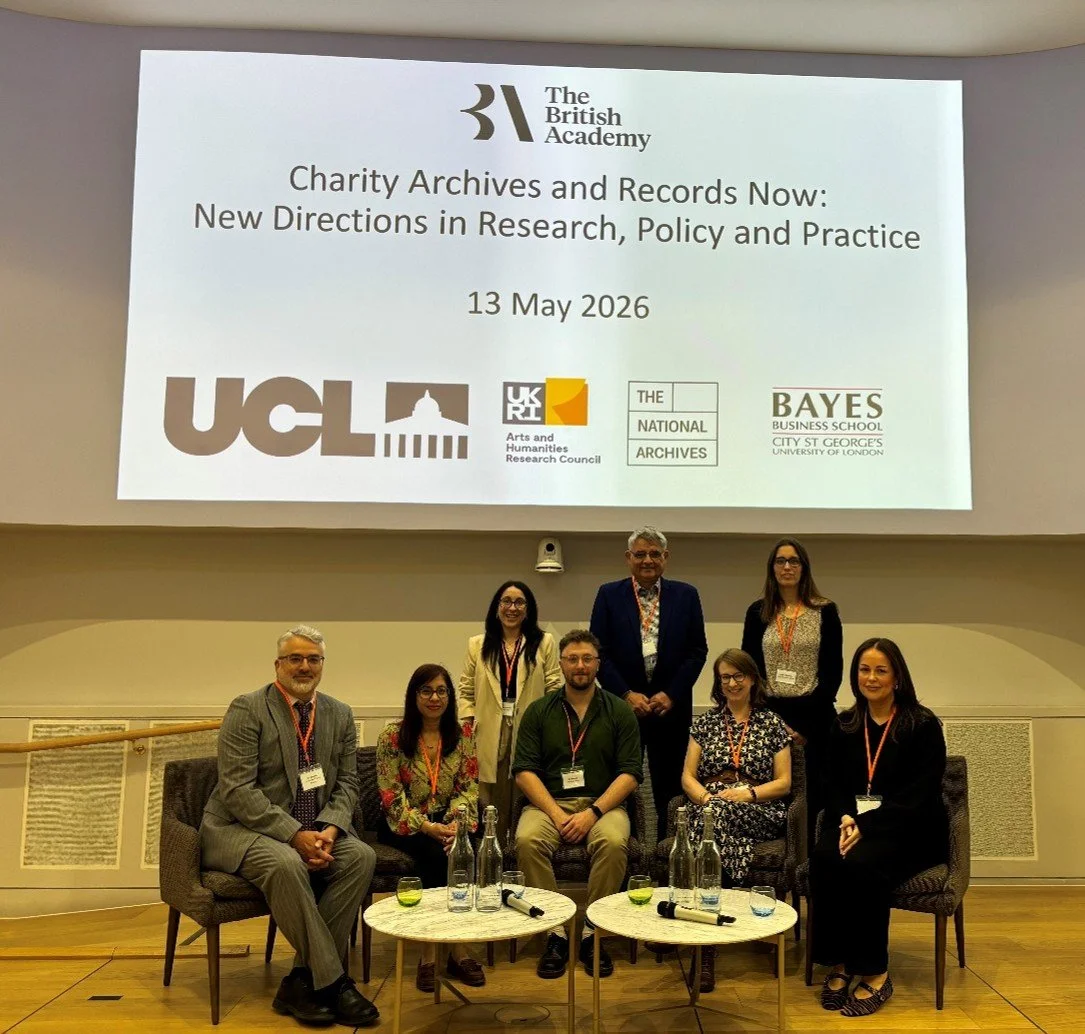
Paul and colleagues at the British Academy